


“What a bore,” says Princess Kaguya after being told by her adoptive father that she cannot invite any of her friends from their village to a banquet. He also scolds her for spending time in the kitchen with her adoptive mother. It’s a strangely bittersweet moment where we see that the life of a princess isn’t all it’s cracked up to be.
 Directed by Studio Ghibli co-founder Isao Takahata and co-written by Riko Sakaguchi, The Tale of The Princess Kaguya is an adaptation of the 10th century Japanese folktale, The Tale of the Bamboo Cutter. An old bamboo cutter (James Caan) and his wife (Mary Steenburgen) discover a tiny girl (Chloë Grace Moretz) inside a shining stalk of bamboo. She’s so small that the wife mistakes her for a doll. It’s not long before she ‘turns’ into a baby. She quickly makes friends who refer to her as ‘Little Bamboo’, though she is later named Kaguya. The bamboo cutter believes Kaguya to be a princess, so he and his wife raise her as one. They later move to the capital city and employ Lady Sagami (Lucy Liu) to train Kaguya to become more “lady-like”. As word travels of Kaguya’s beauty, she is soon inundated with attention from a number of potential suitors.
There are only so many times you can describe a Studio Ghibli film as beautiful. It generally goes without saying. Even with Takahata’s minimalist approach, there is no denying that a single frame from the Oscar nominated The Tale of The Princess Kaguya looks gorgeous enough to hang up on your wall.
Art director Kazuo Oga and storyboard artist Osamu Tanabe lead with hand-drawn watercolours and rough charcoal strokes which are less about filling the space and instead appreciating the elegant details in simple things. Be it when Kaguya lifts a rock and finds insects crawling around, or dancing amid cherry blossoms. At one point Kaguya takes the time to appreciate the simple things herself when she tells her adoptive mother to look at their garden from the floor, remarking how it looks like their former home. While the stark animation may look incomplete, Joe Hisaishi’s wondrous musical score is strong enough to help fill in any blanks.
Studio Canal UK are distributing both the Japanese and English versions of the film. Having viewed the English dub, it takes a while to get used to the accents, but the American voice cast actually sound well suited to their roles. Caan exhibits an occasional gruffness that seems fitting for the bamboo cutter, while Moretz manages to be both solemn and cheerful as Kaguya. A particular standout is Lucy Liu, in a brief role voicing Lady Sagami, who sounds like she’s having fun as a stern tutor for Kaguya.
Moments of humour arise when we see Kaguya being taught how to behave like a noble princess, as well as during many of the scenes involving a number of princes hoping to take Kaguya for a wife. Even though the princes have never seen her, they literally race to meet Kaguya, compare her to impossible treasures and later try their hardest to impress her with some too.
Essentially focusing on Kaguya’s birth and growth to a young woman, at nearly two and a half hours it’s t he longest Studio Ghibli film to date with a few scenes running longer than necessary (like catching a pheasant). Nevertheless it is engrossing, as we see Kaguya’s views when it comes to the expectations placed upon her, like etiquette and appearance, sometimes reluctantly going along, other times defying them. There is also the secret behind Kaguya herself. For someone found inside a bamboo, it’s pretty obvious that something is not quite right about Kaguya, and the film constantly reminds us, be it the comments on her increased growth or her knowledge of a certain song.
Themes such as vanity, materialism and in particular the loss of happiness are shown throughout. Kaguya’s adoptive father declares how he is doing everything to make her happy, yet he slowly turns to using her to attain a higher social status. Even Lady Sagami offers a thin view on happiness, explaining that it is achieved by marrying a gentleman as quickly as possible (interestingly she has no husband herself). By imparting what they believe is good for someone, they never consider if what they’re doing is actually right. For a princess, Kaguya’s own personal freedom is limited and she soon realises how people behave differently around her because of who she is. Without going into spoilers, in a rather telling moment, someone profusely apologises to Kaguya, even though she accidentally does something in which she knows she’s responsible.
Equally joyful and sad, The Tale of The Princess Kaguya has a unique visual style that makes for a mesmerising experience. Even though it is a tale that is centuries old, Isao Takahata’s adaptation proves that the strength of a good story will always resonate with people.
The Tale of The Princess Kaguya opens in the UK on 20 March 2015 and Ireland on 27 March 2015.


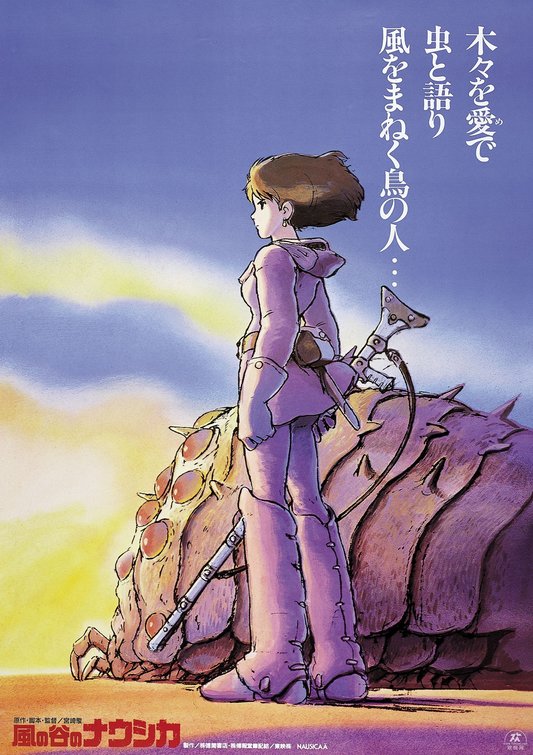
 In an interview on the Japanese channel TBS’s Ō-sama no Brunch program, Hayao Miyazaki said that he would be open to the idea of a possible sequel to Nausicaä of the Valley of the Wind; although, if it were to happen, he would leave it in the hands of Evangelion director Hideaki Anno.