There’s also a new trailer >>>


There’s also a new trailer >>>


Hits Japan in November, and Netflix soon after >>>

 Or should that be referee? The giant monster shared universe that Warner Bros and Legendary are slowly building really is making all the right moves. After the colossally atmospheric but narratively weak 2014 Godzilla and the just stupidly fun Kong: Skull Island earlier this year, next up is the Main Event: Godzilla vs Kong.
Deadline report that Adam Wingard will follow in the footsteps of Gareth Edwards and Jordan Vogt-Roberts. Wingard’s most recent film was the under-rated Blair Witch sequel and he’s also the director of the Netflix version of Death Note we’re getting later this year. However, he’s best known in these parts for The Guest. Starring Legion‘s Dan Stevens, it’s the story of a polite young man who turns up at the family home of a friend and…
Actually you know what? Just watch it. It’s an incredible movie, a staggeringly great and FUN turn from Stevens and it works even better if you go in cold.
Godzilla vs Kong is due for release on 20 May 2020 so there’s plenty of time to buy some popcorn. And flee the area. In the meantime, Wingard’s previous movies are all available to watch or buy now and Death Note will be out later this year.
MCM Midlands was filled with stylish and spot-on cosplay creations…


Earlier this month, Hasbro announced it is working on a five-way shared universe between their various toy properties. This means that GI Joe, ROM the Spaceknight, Micronauts, Visionaries and MASK will all exist in the same universe and, presumably, cross over from time to time.
Let’s have a moment of silence as we all try and picture Roadblock teaming up with ROM and Galadria, the single female Visionary, who turned into a holographic dolphin.
It’s not an image that leaps instantly to mind is it? Unless you get Gina Carano back for Galadria and Vin Diesel as the voice of ROM in which case you’ve got yourself a party. But, fantasy Fast And Furious reunions aside, the thinking behind this move is pretty solid. After all the Marvel Cinematic Universe is a commercial juggernaut that shows no sign of slowing down and it’s about to have a lot of company.

In addition to the Hasbro-verse, DC Comics, Universal’s monsters (The Mummy, Dracula, the Wolfman, Frankenstein’s monster, etc) and Legenadary’s Godzilla and King Kong (via Skull Island) are about to return in their own shared universes as well. And while the Transformers aren’t actually sharing their cinematic universe with anyone, a team of writers has busily been mapping out not just the next Transformers film but the whole next multi-film phase of the franchise using a similar formula (here’s hoping that means the series’ days of racist stereotype autobots, monosyllabic female “characters” and Optimus Prime: Pro Celebrity Murderer are long behind it). There have been hints (from perpetual hinter Vin Diesel) that the Fast And Furious films may go the same way with spin-off and prequels.
Shred universes are clearly the “Future Of Cinema!” Or are they?
The bonuses to the shared universe approach are obvious but there are some major pitfalls too. Here, using the MCU as an example, let’s have a look at a few of them.
 The benefits to this sort of approach are obvious. The crass one is the fact that you’ll hook an audience for life instead of just blockbuster season. The MCU started with Iron Man and is now a rolling flotilla of constantly updating new franchises and sequels. It’s also still active getting on for a decade later and will continue to be so for at least another five years.
Even better, this structure allows a studio to take some risks and absorb some damage. We’ll get to whether or not anyone’s actually taken any risks in a moment but first, let’s talk about that damage and the big green chap who’s taken a lot of it. The Hulk, for all the ridiculous charm Mark Ruffalo brings him, has never exactly been a box office draw. Both the Eric Bana and Ed Norton fronted Hulk movies are fun but the character has never really connected with audiences when out on his own. Worse, with Universal holding first refusal rights on any movies featuring him there’s no real chance of seeing Hulk or his supporting cast on their own anytime soon. Which is a real shame because if the consequences of Civil War demand a single Marvel character, it’s surely Jennifer Walters, attorney at law. Oh, she’s also She-Hulk, in case you didn’t know.
Despite that, Hulk remains a vital and well-liked part of the MCU. Part of that’s because Ruffalo is so good in the role but most of it is due to Marvel – despite the two unsuccessful movies – being able to drop him into the Avengers. The film was a near-certain hit, Captain America, Iron Man and Thor were already bringing their audiences to the table and it was a chance to reinvigorate a character while giving audiences most of the Avengers line-up they wanted.
Better still, the added depth of having multiple established characters like that in one universe means everything has added consequence and weight. The collapse of SHIELD in The Winter Soldier is a great example, an event that’s defined close to two seasons’ worth of Agents of SHIELD and has cast a shadow over every Earth-based Marvel movie for years. Now the universe is set up, it’s changing. And those changes are having a knock on effect everywhere. The catastrophic after-effects of the Sokovia incident, Cap’s need to save Bucky, War Machine wanting to be recognised as a hero in his own right and so on. Done right – as the MCU often is – a shared universe gives you the chance to not only try new things but also to use a single event to alter multiple stories and re-engage multiple audiences.
 Conservative choices
But to keep those audiences you have to keep surprising them and that means you have to take risks. And the one thing the MCU categorically has not done, outside the mild chance it took on Guardians Of The Galaxy, is take risks. Iron Man was released in 2008. The first Marvel movie featuring a female lead, Captain Marvel, will be released in 2019. The fact that release date is over a decade after the MCU launched is insulting. The fact that Captain Marvel’s been moved twice, once to make room for yet another Spider-Man movie is farcical. At least one of the other movies it’s shifted for, Black Panther in 2018, features the first MCU black lead character so there’s that. But taking a decade to acknowledge not every hero is a white guy cannot be viewed as anything other than formulaic and dangerously conservative.
It’s not all bad news of course, with Ant-Man And The Wasp bringing Evangeline Lilly’s barnstorming Hope Van Dyne back to the screen in 2018. But close to a decade in, the MCU is structurally complex and socially desperately simplistic. To be successful that’s something every shared universe following in its footsteps has to avoid.
There are other major problems too. The most obvious is the sense of “missing the bus” that some viewers will inevitably get. Imagine starting in on the MCU now. You’re faced with 12 movies, two Netflix series, two-and-a-half seasons of Agents of SHIELD and one of Agent Carter with further seasons of all of them, Luke Cage, Iron Fist, The Defenders, Damage Control and 11 more movies between now and 2020. That’s not a catch-up, that’s a second job.
Worse still is mission creep which Civil War has already been threatened by. The presence of the other Avengers makes perfect sense but the addition of Spider-Man can only be described as a little worrying. This is a movie that now has to do four jobs; round out Cap’s trilogy, set up the Infinity War movies, introduce one of Marvel’s most iconic characters and tell a coherent story. If anyone can do it it’s this cast and crew they’ve got but that’s still a big ask.
Then there’s the need to constantly raise both the stakes and the scale. The stakes aren’t a huge problem and, again, the MCU shows us how it can be done. The Iron Man trilogy is a very smart, way-funnier-than-you’d-expect story about a man growing up in public with added power armour and explosions, for example.

Scale is a real problem though and you need look no further than Age Of Ultron for proof of that. Joss Whedon’s talked about the “checklist” he had to work from with that movie and it’s a testament to how good he and his team are that it rarely shows. Regardless it’s a crammed film that does occasionally show the strain and if there’s a concern about Civil War, it’s surely that it will be Avengers 2.5 and have similar overcrowding problems. Again, to be successful, future shared universes will have to balance this constant demand for more of the same as well as more of the new, often at the exact same time. Early word is that the DC Universe movie Suicide Squad manages this very well but we’ll have to wait and see.
So, shared universes aren’t a magic bullet. They offer huge benefits but huge pitfalls too and, just under ten years into the MCU, its clear studios are still learning how to use them.
That’s actually a really good thing. The various shared universes about to roll out will bring new tricks and perspectives to the table. Some won’t work, some will absolutely soar and everything that follows them will take those successes and do even more new and interesting things with them.
In other words, shared universes mean everyone gets to play with the same toys, in some cases literally as we see with Hasbro. But the more toys we have, the better the stories will be. At least in the long run.
Alasdair Stuart


You may think that the last thing you’d want to do with a monster famed for smashing up your country is make him a permanent resident, but whoever said the movies or fandoms made sense?
No, you didn’t read wrong: the legendary radioactive sea monster has been officially registered as a citizen of Japan, after papers were drawn up by city officials to claim him as a resident of Shinjuku, Tokyo. 5,000 copies of these papers have been printed and distributed free to fans on a first come, first served basis.
Don’t worry though: if you can’t afford a flight out to Japan, or whatever price the documents end up being sold on for on eBay, at least you can still find out what they say. According to Rocket News, the papers read as follows:
Name: Godzilla
Address: Shinjuku-ku, Kabuki-cho, 1-19-1
Date of birth: April 9, 1954 [the year of the release of the very first Godzilla film]
Date of becoming a Shinjuku resident: April 9, 2015
Reason for special residency: Promoting the entertainment of and watching over the Kabuki-cho neighbourhood and drawing visitors from around the globe in the form of the Godzilla head built atop the Shinjuku Toho Building.
Previous visits to Shinjuku Ward: 3 times; Godzilla (1984), Godzilla vs. King Ghidorah(1991), Godzilla 2000 Millennium (1999)
Lest we forget, the original 1954 movie ended with attempts by the city’s inhabitants to destroy Godzilla, so things have certainly changed. With “watching over the Kabuki-cho neighbourhood” given as one of the reasons for his acceptance, perhaps more sympathetic portrayals in subsequent films had something to do with with the decision. That, or it’s a clever marketing ploy both for Toho and Tokyo tourism.
Sources: IGN | Rocket News
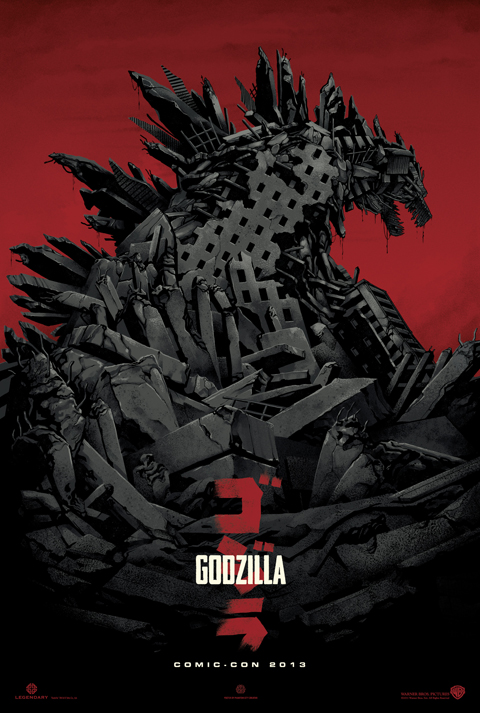
IGN has revealed the poster for Gareth Edwards’ Godzilla remake, which will debut at Comic-Con.

Edwards and Legendary Pictures also said that “something very big is heading to San Diego” in a teaser video:
Shooting began in Canada this March, and is set to open on 16 May, 2014. The cast includes Aaron Taylor-Johnson, Elizabeth Olsen, Ken Watanabe, David Strathairn, Bryan Cranston, Richard T. Jones, Juliette Binoche, and Sally Hawkins.

Masses of monster movies rebooting? Here are five lame films we could have lived without the first time around…